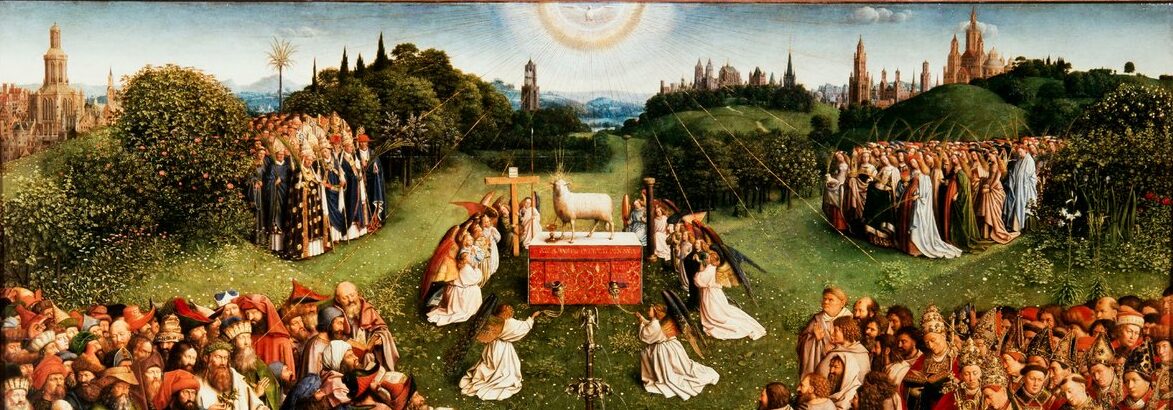
The Star of Bethlehem: Divine Light in the Celestial Order –
An Explanation According to Johannes Kepler
Dear faithful in Christ,
In this sacred time after the feast of Our Lord’s Nativity, our hearts are drawn to the mysteries of Bethlehem, where the Word made flesh dwelt among us. Among these wonders stands the Star that guided the Magi from the East to adore the newborn King, as recounted in the Gospel of Saint Matthew: “Where is he that is born king of the Jews? For we have seen his star in the east, and are come to adore him” (Matthew 2:2). This celestial sign, a beacon of divine providence, called the first Gentiles to the cradle of salvation, fulfilling the prophecies: “The Gentiles shall come to thy light, and kings to the brightness of thy rising” (Isaiah 60:3).
The eminent Catholic astronomer and mathematician Johannes Kepler (1571–1630), a man of profound faith who viewed his scientific pursuits as a hymn to the Creator’s wisdom, offered a pious and rational hypothesis for this Star. Rooted in his observations and calculations, Kepler’s explanation harmonizes natural astronomy with God’s providential design, without contradicting the possibility of a miraculous intervention. As a devout Catholic, Kepler remained loyal to the Church, enduring persecution for his faith in Protestant regions, and he integrated his discoveries with theological reverence, seeing the heavens as declaring “the glory of God” (Psalm 18:2).
Kepler’s interest in the Star arose from his sighting in 1603–1604 of a conjunction between Jupiter and Saturn, followed by a nova (a “new star,” now understood as a supernova). This event prompted him to compute similar phenomena around the time of Christ’s birth. In his 1606 work De Stella Nova in Pede Serpentarii and further in 1614 publications, he determined that a rare triple conjunction of Jupiter and Saturn occurred in 7 BC within the constellation of Pisces – a date aligning with traditional chronologies of the Nativity, before Herod’s death in 4 BC. This conjunction involved the two planets appearing to approach each other closely three times: in May, September/October, and December of that year, creating an unusually bright point of light visible to the naked eye.

For the Magi – wise men from the East, versed in astronomy and likely influenced by Babylonian traditions – this was no ordinary sight. Jupiter, the largest planet, symbolized royalty and kingship; Saturn represented the Jewish people or the end of an era; and Pisces was associated with Judea or the Messianic age. Thus, the conjunction could be interpreted as heralding the birth of a great King in Judea, prompting their journey. Kepler saw this as God’s use of natural causes to fulfill His salvific plan, much as Saint Thomas Aquinas teaches that celestial bodies can influence earthly events under divine ordinance (Summa Theologica, Ia, q. 115, a. 4).
Kepler’s hypothesis elegantly accounts for the Gospel’s details through observable astronomical phenomena, without denying a supernatural dimension if God so willed:
- The Apparent Movement of the Star: Planets exhibit a westward progression across the sky night after night, due to Earth’s rotation and their orbits. The Magi, observing from the East (likely Persia or Babylon), would see the conjunction rise in the east and move westward, guiding them toward Judea over months. This matches: “Behold the star which they had seen in the east, went before them” (Matthew 2:9). Kepler emphasized that such motion was predictable for astronomers, allowing the Magi to follow it as a divine sign.
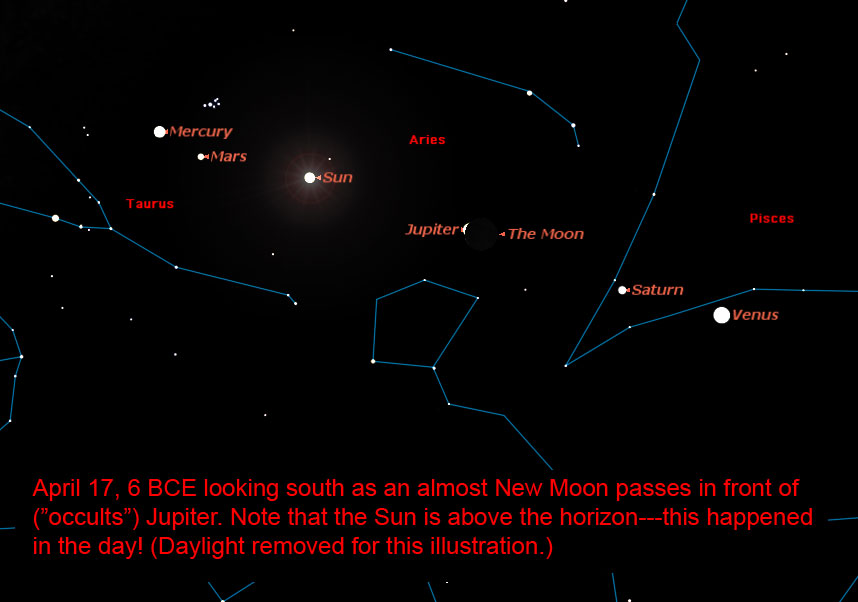
- Its Disappearance over Jerusalem: When planets align closely with the Sun from Earth’s perspective, they become invisible, obscured by solar glare during the day or near dawn/dusk. Kepler calculated that during the Magi’s arrival in Jerusalem, the conjunction was in such a phase, temporarily “disappearing.” This explains why they inquired of Herod: the Star faded, compelling them to seek human counsel, thus fulfilling prophecy and involving the tyrant in the divine drama.
- Its Reappearance: The triple aspect was key: after the first conjunction in May (perhaps initiating their preparations), the planets separated slightly before reconverging in September/October and December. This created the illusion of the bright “Star” waning and then reemerging stronger, urging the Magi to continue from Jerusalem southward to Bethlehem after their audience with Herod.
- Its Standstill Above the Child: Kepler’s most brilliant insight involved planetary retrograde motion – an optical illusion where a planet appears to slow, halt (in its “stationary” phase), and reverse direction due to Earth’s overtaking orbit. In December 7 BC, Jupiter entered this stationary phase precisely, appearing to “stand still” over Bethlehem for several days. As the Gospel states: “Until it came and stood over where the child was” (Matthew 2:9). This providential timing crowned the event, directing the Magi to the exact spot.
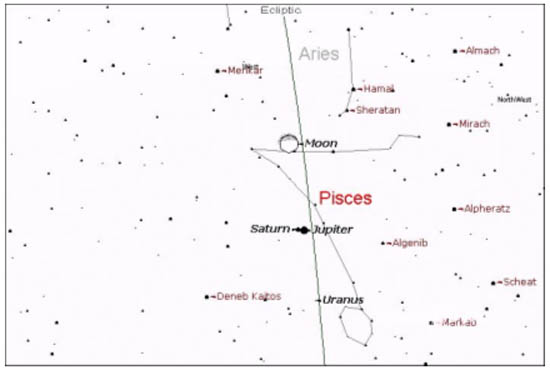
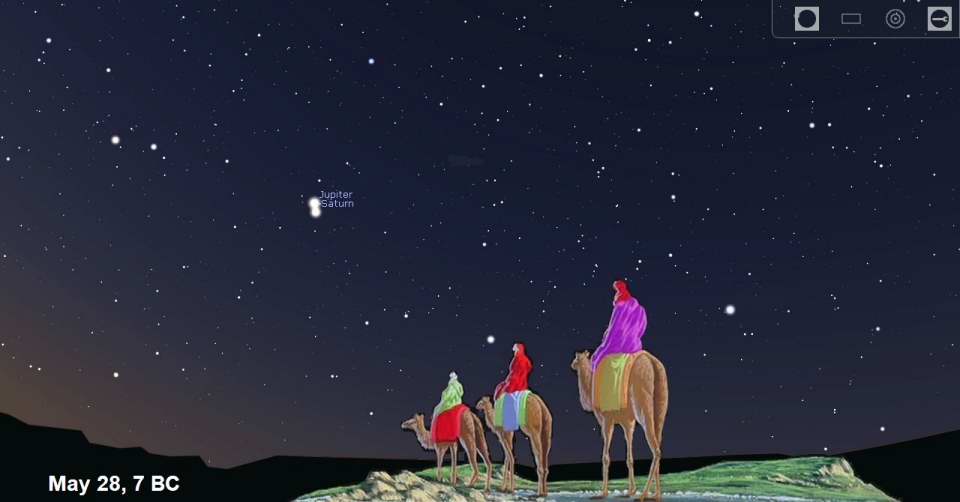
This explanation, while an opinion among theologians and not a defined dogma of the Church, exalts God’s sovereignty over creation. The holy Catholic Church, in her unchanging doctrine before the modern crises, teaches that God can employ secondary causes (like planetary motions) for His miracles, as seen in the plagues of Egypt or the sun standing still for Joshua (Josue 10:12-14). Whether the Star was this conjunction, a comet, a miraculous light akin to the Shekinah glory, or something else, its purpose was certain: to lead souls to Christ, the true Light of the World (John 8:12).
Beloved in the Lord, let this mystery inspire us to fidelity. In these times of apostasy, as foretold in Scripture, cling to the true Catholic faith as taught immutably until 1963: the traditional Mass, the sacraments in their ancient rites, daily Rosary, and penance. May the Star of Bethlehem guide us, as it did the Magi, to adore Our Lord in spirit and truth, under the mantle of the Blessed Virgin Mary, Star of the Sea.
In union of holy prayers, Your servant in Christ.