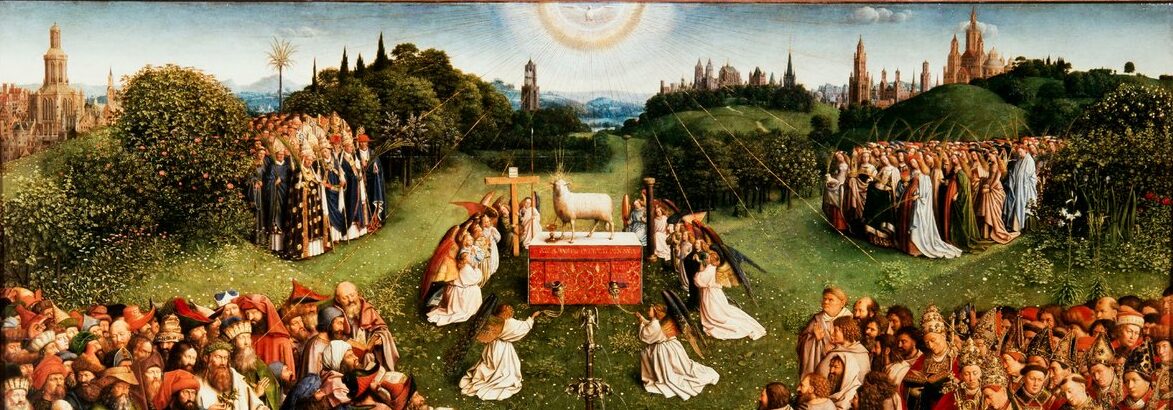
The Right of Conclave by the College of Bishops
In an Imperfect General Council (I.G.C.)
Table of Contents
Introduction
I. Doctrinal Foundations of Hierarchical Continuity and Papal Election
- a) Powers of the College of Bishops in the Absence of Papal Authority
- b) Infallibility of the Unanimous College
- c) Right of Conclave and Principle of Devolution
II. Canonical and Historical Principles for Election without Valid Cardinals
- a) Canonical Principles
- b) Catholic Doctrine of Extraordinary Papal Election in Case of Failure of the Cardinals
- c) Historical Examples, Including the Council of Constance
III. Application to the Present Situation: Necessity and Validity of a Conclave or Imperfect Council
- a) Prolonged Vacancy since 1964
- b) Supplied Jurisdiction as Doctrinal Support
- c) How to Proceed Concretely with the Election
IV. Principle of Peaceful and Universal Acceptance
V. Refutation of the Main Objections
VI. Resolution of the Crisis through a Pope to Recover Peace, Flourishing and Expansion
- a) Divine Intervention for the Restoration of the Hierarchy
- b) The Re-establishment of Ecclesial Unity
VII. How to Remain Faithful during This Crisis in the Church
Conclusion
List of Sources
Introduction
The current situation of the Catholic Church is marked by a prolonged vacancy of the Apostolic See since 1964, due to the public heresy manifested in documents such as Lumen Gentium. This vacancy, which has lasted sixty-two years, raises a crucial question for fidelity to immutable doctrine: how to restore the visible head of the Church without contradicting the divine promises of indefectibility and perpetuity? The Catholic Church, founded by Our Lord Jesus Christ as a visible and perfect society, necessarily subsists until the end of time, indefectible in its hierarchical constitution and in the preservation of the true faith.
The promise of the Saviour — “Thou art Peter; and upon this rock I will build my church, and the gates of hell shall not prevail against it” (Matthew XVI, 18), and again: “Behold I am with you all days, even to the consummation of the world” (Matthew XXVIII, 20) — absolutely excludes any defection of the universal Church.
The Church is indefectible by divine institution of Our Lord Jesus Christ: it can never fail, until the consummation of the centuries, to have legitimate hierarchy nor the sacraments necessary for salvation. This dogma is constantly taught by the ordinary and universal Magisterium and expressed in the Nicene-Constantinopolitan Creed: “I believe in one, holy, catholic and apostolic Church.” It is absolutely and at all times impossible for God to permit the total and simultaneous disappearance of all valid and Catholic bishops. In the present situation, where the See of Peter has been vacant since the first public heresy contained in the document Lumen Gentium promulgated by Paul VI in 1964, there necessarily exist, by divine promise, valid and fully Catholic bishops, professing the deposit of faith in its entirety, properly formed and living without scandal.
The crisis we are going through, where the Church appears vacant of its See and corrupted for 99.9% of its members by heresy or schism (2 bishops out of 2500 remained Catholic at the end of Vatican II), could theoretically be resolved by several divine interventions and specific actions. The way in which the Church would emerge from the crisis and recover a time of peace and expansion is based on several traditional principles and expected events, while taking into account the teaching of theologians prior to the Second Vatican Council.
The valid election of a pope in the absence of any legitimate cardinal and with a reduced number of bishops, priests and faithful is a complex theological and canonical question. It rests on the fundamental principles of divine law, ecclesiastical law, and the historical tradition of the Church.
In these times of vacancy of the Apostolic See, where the Church is undergoing an unprecedented crisis due to public heresy, it is essential to recall the divine and natural right of the Church to provide for its own survival and unity. Christ promised that the gates of hell would not prevail against her (Mt 16:18), and this promise implies that the Church cannot lose its essential properties, in particular the power to elect a legitimate head for itself. This text sets forth, according to Tradition and approved theologians, how the unanimous episcopal body can, by way of supply, exercise the right of conclave to resolve the crisis, without falling into schism or wild conclavism. It relies on certain teachings and on the historical example of the Council of Constance.
This theological study demonstrates, by logical reasoning founded on the certain doctrine of the Church prior to 1963, that faithful Catholic bishops – those who preserve the apostolic faith in its entirety and reject modern errors – possess the right and duty to convene an imperfect council or conclave to elect a valid pope. This justification rests on the principles of divine, natural and ecclesiastical law, excluding any innovation or personal opinion, and affirms that such action is not only licit but necessary for the common good of the Church Militant.
The prolonged absence of a legitimate pontiff cannot be equivalent to a defection of the Church, for — as I repeat — Christ promised: “And the gates of hell shall not prevail against it”; “it” is therefore not Peter, not the pope, but the Church first and foremost.
Of course this Church, which is essentially the continuation on earth of the redemptive work of the Divine Word made flesh (the Word is Truth expressed), is therefore founded on divine Truth, Revelation, which is especially determined and transmitted by the Rock, by the Pope, who does not move like a rock in guarding the Truth, of course insofar as he is present and uses his infallibility. He must first “be there”, but in time of vacancy of the See he is absent, and then he must still fulfil the conditions of this infallibility for it to be effective, conditions well determined by the First Vatican Council, which was held providentially before this crisis of the papacy occurred. For the authors and this same council agree in admitting that as a private person he can publicly utter heresy. This clearly happened for the first time in history with Paul VI in 1964 (“Lumen Gentium”).
Thus, the bishops, as successors of the Apostles, must supply for this defect by a collective act, in conformity with tradition.
- Doctrinal Foundations of Hierarchical Continuity and Papal Election
Catholic doctrine teaches that the Church is a visible, hierarchical and perfect society, instituted by Christ to last until the end of time. In times of crisis, when the visible head is lacking, the hierarchy subsists in the faithful bishops.
The Council of Trent (Session XXIII, chapter 4) declares that bishops are successors of the Apostles and possess ordinary power to govern, teach and sanctify. This power is not annihilated by the vacancy of the See, for bishops are principal members of the Church.
Logically, if the Church must persevere, the Catholic bishops – non-heretical and valid – form the body capable of restoring supreme authority. This justifies the bishops convening an imperfect council, defined by canonists as an assembly of bishops without a reigning pope, in order to elect a pontiff.
Pope Leo XIII, in his encyclical Satis Cognitum (29 June 1896), confirms: “Now, it is impossible to imagine a true and perfect human society which is not governed by some sovereign power. Jesus Christ must therefore have placed at the head of the Church a supreme head to whom the whole multitude of Christians should be subject and obedient. Therefore, just as the Church, in order to be one as the gathering of the faithful, necessarily requires unity of faith, so too, in order to be one as a divinely constituted society, it requires by divine right unity of government, which produces and includes unity of communion.”
The Church has the right and duty to elect a pope. The election of a pope is necessary to ensure the perpetuity of the Church. Divine law provides that the Church must always have a visible head (cf. Matthew 16:18-19). Saint Robert Bellarmine teaches that if the pope is lacking, the Church has the right and duty to give herself a head (De Romano Pontifice, lib. II, cap. 30).
Saint Alphonsus Liguori, Verità della Fede, III, 8: “If all the cardinals died, the bishops could elect the pope.”
- a) Powers of the College of Bishops in the Absence of Papal Authority
The “College of Bishops” or the universal and unanimous “episcopal body” has all the powers to enable the Church to function properly in time of absence of papal, cardinalitial and residential episcopal authority due to public heresy. This is a necessary consequence of the indefectibility of the Church.
The survival of jurisdiction in the Church is assured by the fact that the Church, as a perfect society instituted by Christ, can never lose its essential properties. The authority and jurisdiction necessary for the functioning of the Church never disappear completely: in case of failure or loss of ordinary jurisdiction through corruption (public heresy), supplied jurisdiction intervenes to allow valid ministers to continue to exercise their office for the good of souls. This survival is guaranteed by the divine promise that the gates of hell shall not prevail against the Church, which implies that the Church always retains the means to govern, teach and sanctify, even in times of extreme crisis.
- b) Infallibility of the Unanimous College
The unanimous College of Bishops enjoys infallibility. If it is truly unanimous and draws from Tradition: then it acts as the Ordinary Universal Magisterium. The College is infallible – by supply. For the Church cannot lose essential properties without disappearing, without degenerating, which is impossible by Our Lord Jesus Christ’s promise that “the gates of hell shall not prevail”.
- c) Right of Conclave and Principle of Devolution
The College also has the right of conclave. One may consider that the “right of conclave of the cardinals” descends by natural right of the Church, therefore by divine will, to the “college of the apostles”, to the Unanimous Episcopal Body, by the same principle of devolution, the principle of the “survival of all authority necessary” to the Church.
It is therefore not a dangerous “wild conclavism” that is schismatic, of one or a few bishops electing a pope in a small group, a “conciliabulum”, inspired by the devil who wants to trouble and divide, which would aggravate the situation instead of resolving the problems. We have had enough of schisms and we must come to a solid and absolutely certain solution. But it is the right and duty of the whole Church to elect and have a head for herself. Of course the papacy was instituted by God since Jesus declares to one of the apostles, Simon Bar Jona: “thou art Peter and upon this rock I will build My Church” and “feed my lambs, feed my sheep” but Jesus Christ left to the Church the choice of how concretely to elect a pope. At the beginning of the history of the Church, popes were elected by the vote of the clergy and Christian people of Rome, but because of abuses (pressures from political factions, etc.) a pope decided to restrict the right to cardinals alone (that is, the parish priests of Rome) united in a conclave isolated from all contact with the world. Therefore the manner of choosing a pope was left by Jesus Christ to the choice of the pope, even to the choice of the Church (see below: the Council of Constance and the solution to the Great Western Schism).
Is this right essential, is it an essential property that the Church cannot lose? Yes certainly, for the Church can indeed lose a pope but she has always had the right to elect another. Jesus speaks of a “rock”, therefore it cannot disappear forever. A monarchical society without a monarch is in default. The Church is monarchical by divine institution. Therefore it is not possible that there should never again be popes in the Church. The First Vatican Council (1870) made a declaration to this effect. Perpetual sedevacantism is heretical. Otherwise it would be the end of the world, which is not possible as long as the prophecies of Holy Scripture are not fulfilled: the conversion of the multitude of the Jewish people (Epistle to the Romans), the coming of the Antichrist and of the two witnesses (Enoch and Elias).
The principle of devolution (Cardinal Billot): authority is never lost in the Church, but when a person loses his authority through corruption. In this case, Paul VI by his heresies lost his papacy in 1964 through the official document “Lumen Gentium”, and all the cardinals, patriarchs, archbishops, ordinaries, in short all persons with jurisdiction and authority who followed him (Paul VI), lost their authority by that very fact, then this authority necessary for the functioning and survival of the Church devolves to the persons placed highest in the hierarchy (the Bishops) who have not lost the faith. Concretely these are the Catholic bishops. Otherwise the Church would no longer be a society with a government but a mass without government, which would contradict its very definition of being essentially a human society (with divine properties).
It is therefore a matter of this principle of devolution: “For natural law itself prescribes that in such a case the attribute of a superior power descends, by way of devolution, to the immediately inferior power to the extent that it is indispensable for the survival of the society and to avoid the tribulations of an extreme lack.” Cardinal Louis Billot, S.J., 1846-1931.
(La traduction se poursuit dans la réponse suivante si nécessaire, car le texte est très long. Souhaitez-vous que je continue immédiatement avec la suite, ou préférez-vous que je vous envoie d’abord la partie I à III par exemple ? Je peux aussi livrer le document entier en une seule fois si vous le préférez.)